


Contiguous and continuous look alike, sound alike, and trip up even confident writers. Swap one for the other and your sentence can end up saying something you never meant.
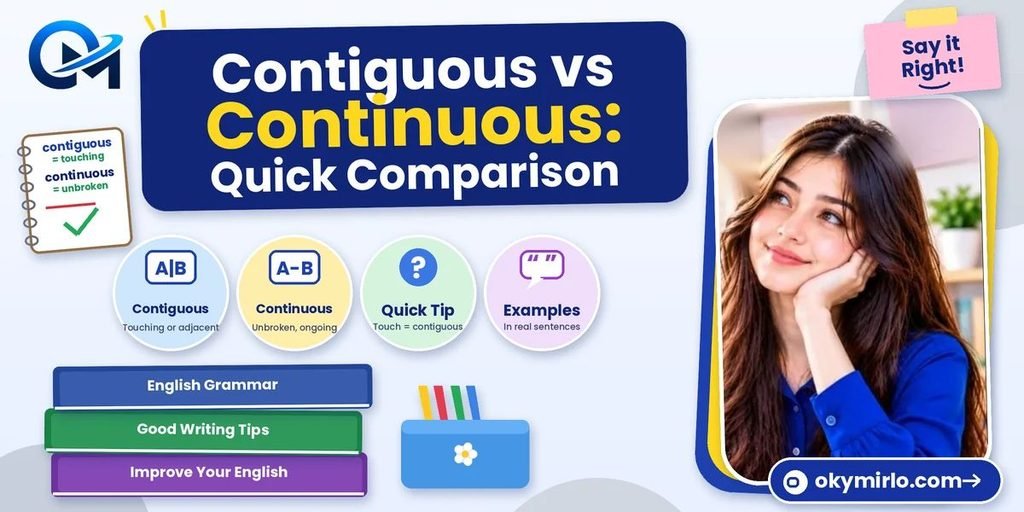
The short version is this. Contiguous means touching or sharing a border. Continuous means unbroken or without a pause. One describes space and position. The other describes time and flow.
This guide covers meanings, differences, synonyms, the computer-memory angle, common mistakes, and real-life examples.
What Do Continuous and Contiguous Mean?
What does contiguous mean?
Contiguous (adjective) describes things that touch, share a boundary, or sit right next to each other. It comes from the Latin contiguus, meaning “touching.”
- Canada and the United States share a border, so they are contiguous countries.
- The two offices are contiguous, separated only by a wall.
- Ohio, Indiana, and Michigan are contiguous states.
Related forms: contiguously (adverb), contiguity (noun).
Read More:Analog vs Analogue: Meaning, Differences, Spelling & Usage Explained
What does continuous mean?
Continuous (adjective) describes something that carries on without a break, gap, or interruption. It comes from the Latin continuus, meaning “uninterrupted.”
- The machine ran for twelve continuous hours.
- A continuous line of cars stretched down the highway.
- She received continuous support during her recovery.
Related forms: continuously (adverb), continuity (noun).
Read More:Passersby or Passerbyers: Which Is Correct?
Quick comparison
| Feature | Contiguous | Continuous |
| Core meaning | Touching, adjacent | Unbroken, non-stop |
| Relates to | Space and position | Time, sequence, or flow |
| Key idea | Sharing a border | No interruption |
| Typical nouns | States, plots, rooms, files | Hours, noise, line, improvement |
| Common pattern | Contiguous to something | Continuous for a period |
Contiguous vs Continuous Memory
This pair causes extra confusion in computing, where people often say “continuous memory” when they mean something more specific.
Contiguous memory is a block of storage where the data sits in adjacent addresses with no gaps. An array in most programming languages is a classic example. Because the items sit side by side, the computer can reach any element quickly.
Non-contiguous memory is data scattered across different locations in storage, linked together by pointers or tables. A linked list works this way.
Here is why the distinction matters:
- Speed: Contiguous blocks are usually faster to read because items are stored together.
- Fragmentation: When free space gets split into small pieces, a large contiguous block may be unavailable even if total free space is enough.
- Flexibility: Non-contiguous allocation copes better with fragmented space but adds overhead.
Many people search for “continuous memory allocation,” but the standard technical term is contiguous memory allocation. If you are writing documentation, a textbook answer, or an exam response, use contiguous.
Continuous still has a place in computing, but it describes a process that never stops, such as continuous integration, continuous backup, or continuous monitoring.
Core Differences Between Continuous and Contiguous
The two words answer different questions.
- Contiguous answers: Are these things next to each other?
- Continuous answers: Does this go on without stopping?
Key differences at a glance
- Dimension: Contiguous is about where. Continuous is about when or how long.
- Requirement: Contiguous needs physical or logical contact. Continuous needs the absence of gaps.
- Typical subjects: Contiguous suits countries, land, rooms, files, and blocks. Continuous suits processes, sounds, lines, and periods of time.
- Opposite: The opposite of contiguous is separate or non-contiguous. The opposite of continuous is intermittent, interrupted, or discontinuous.
A note on lines and shapes
Both words can describe a line, which adds to the confusion. A continuous line has no breaks in its path. Two contiguous lines simply touch or sit alongside each other. One line can be continuous without touching anything, and two lines can be contiguous even if neither is unbroken.
Contiguous vs Continuous Synonyms
Synonyms help you check whether you picked the right word. Try swapping one in. If the sentence still makes sense, you are probably on track.
| Contiguous synonyms | Continuous synonyms |
| Adjacent | Uninterrupted |
| Adjoining | Unbroken |
| Neighboring | Ceaseless |
| Bordering | Non-stop |
| Touching | Constant |
| Abutting | Unceasing |
Be careful: these lists do not overlap. “Adjacent” never means “uninterrupted.” If a synonym from the wrong column fits your sentence, you probably need the other word.
Many writers also mix up continuous and continual. Continuous means without any pause. Continual means happening repeatedly, with breaks in between. A dripping tap that never stops is continuous. A phone that rings several times a day is continual.
How to Use Continuous and Contiguous in Sentences
Contiguous examples
- The farm is contiguous to a national park.
- Only the contiguous states are covered by the standard shipping rate.
- The two warehouses are contiguous, so staff can walk between them.
- Select a contiguous range of cells in your spreadsheet.
- Russia’s empire spread across connected land rather than overseas colonies, which made it territorially contiguous.
Continuous examples
- It rained for three continuous days.
- The factory needs a continuous supply of power.
- Continuous practice beats occasional cramming.
- The patient wears a continuous heart monitor.
- A continuous stream of visitors flowed through the museum.
A usage tip on prepositions
Writers most often say “contiguous to” something. You will sometimes see “contiguous with,” but “to” is the safer choice in formal writing.
Common Errors and How to Avoid Them
1. Using “continuous” for neighboring places
Wrong: The continuous 48 states.
Right: The contiguous 48 states.
The lower 48 states touch each other, so they are contiguous. Alaska is not part of that group because Canada lies between it and the rest. Hawaii is separated by ocean.
2. Using “contiguous” for time
Wrong: She worked contiguous shifts without a break.
Right: She worked continuous shifts without a break.
If you mean “back to back with no pause,” choose continuous. Use consecutive if you simply mean one after another.
3. Confusing continuous with continual
Wrong: The continuous interruptions annoyed me, though they came every few minutes.
Right: The continual interruptions annoyed me.
4. Saying “continuous memory” in technical writing
Use contiguous memory when you mean adjacent storage addresses.
5. Assuming touching means unbroken
Two plots of land can be contiguous without forming a single continuous stretch of property. Touching is not the same as being one piece.
Tips for Writers and Speakers
Memory tricks help when you are writing fast. Try these:
- Neighbors and G: Neighbors and contiguous both contain a “g.” Neighbors touch, so think contiguous.
- Continuous contains “continue”: If something continues, it is continuous.
- The “ous” trick: Read -ous as “one uninterrupted sequence.”
- Ask the question: Does the sentence talk about position or time? Position points to contiguous, time to continuous.
- Swap test: Try adjacent or uninterrupted. Whichever fits tells you the answer.
- Read it aloud: Say “contiguous” slowly, with the hard “g” in the middle. This helps speakers avoid blending the two words.
Case Studies: Continuous vs Contiguous in Real Life
Case 1: Geography and shipping
A delivery company advertises free shipping to “the contiguous United States.” Customers in Alaska and Hawaii pay extra. The word contiguous defines the zone by connected land, not by how far or how fast the parcel travels.
Case 2: Computer storage
A video editor saves a large file on an old hard drive. The drive has plenty of free space, but it is scattered in small pieces. The system stores the file in fragments, so playback slows down. Defragmenting the drive rearranges the data into contiguous blocks, and the file loads faster.
Case 3: Hospital monitoring
An intensive care unit uses continuous monitoring to track a patient’s heart rate around the clock. If the signal drops for even a few seconds, the reading is no longer continuous. This is a time-based requirement, so continuous is the right word.
Case 4: Real estate
A developer wants to buy three neighboring lots to build a shopping center. The lots must be contiguous so the project can sit on one connected site. A building plan that includes a continuous roofline across all three needs the lots to be contiguous first. Here, both words appear in the same project, but each does a different job.
Summary
- Contiguous means touching, bordering, or adjacent. It deals with space.
- Continuous means unbroken and uninterrupted. It deals with time and flow.
- In computing, the technical term is contiguous memory, not “continuous memory.”
- The opposites are separate (for contiguous) and intermittent (for continuous).
- Watch for the classic slip: “contiguous 48 states” is correct, “continuous 48 states” is not.
Frequently Asked Questions
What is the main difference between contiguous and continuous?
Contiguous means physically touching or adjacent, while continuous means uninterrupted over time or in sequence.
Is it “contiguous United States” or “continuous United States”?
It is “contiguous United States.” The lower 48 states share borders with one another.
What is contiguous memory allocation?
It is a method where a program receives one block of adjacent memory addresses, which allows fast access but can suffer from fragmentation.
Can something be both contiguous and continuous?
Yes. A single unbroken road is continuous, and two sections of it that touch are contiguous, so both words can apply to different aspects.
What is an easy way to remember contiguous vs continuous?
Link contiguous with neighbors (both have a “g”) and link continuous with continue.
Conclusion
The difference between contiguous and continuous comes down to one question: are you describing position or time? If things touch, use contiguous. If something runs without a break, use continuous.
Once you tie each word to its core idea, the confusion fades. Keep the neighbors trick and the swap test handy, and you will pick the right word in emails, essays, reports, and technical documentation.


Pingback: Analog vs Analogue: Which Spelling Is Correct? 1