
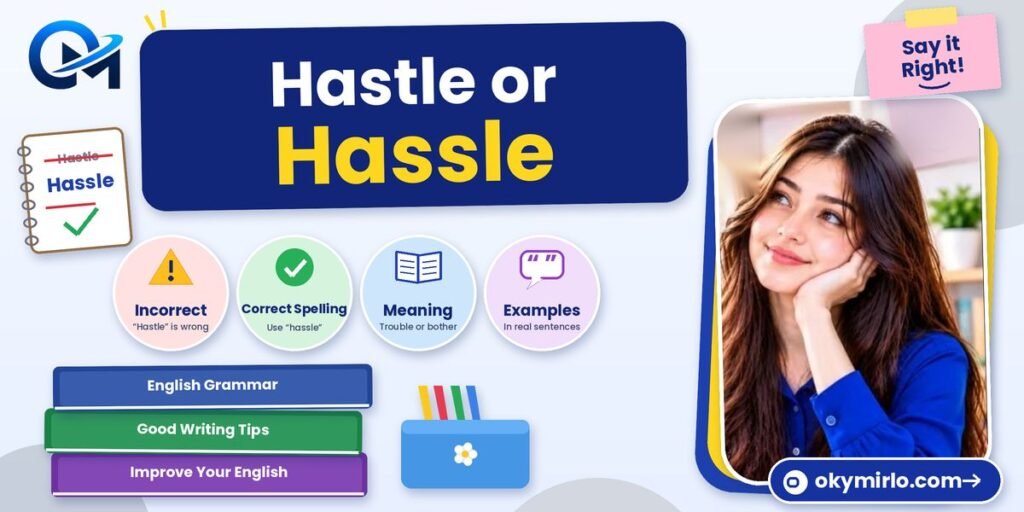

If you’ve ever typed “hastle” and paused, wondering if it looked right, you’re not alone. This is one of the most common spelling mix-ups in English, and it trips up even confident writers. The short answer: hassle is correct, and hastle is not a real word.
This guide breaks down everything you need to know: the correct spelling, what hassle actually means, how to use it as a noun and verb, where it came from, and simple tricks to make sure you never misspell it again.
Read More:Company-Wide or Companywide: Which Spelling Is Correct?
The Correct Spelling: Hassle (Not Hastle)
Let’s settle it right away: hassle is the only correct spelling. It’s spelled with a double “s” and no “t” — H-A-S-S-L-E.
“Hastle” is a misspelling, plain and simple. It doesn’t appear in Merriam-Webster, Oxford, Cambridge, or any other recognized dictionary. It shows up so often in casual writing, texts, and social media that some people assume it might be an accepted variant. It isn’t.
| Spelling | Status | Where You’ll See It |
| Hassle | ✅ Correct | Dictionaries, published writing, professional content |
| Hastle | ❌ Incorrect | Typos, casual texts, social media, autocorrect errors |
| Hustle | ✅ Correct (different word) | Refers to working hard or moving quickly |
Read More:“And I’s” or “And My”? Is “And I’s” Correct Grammar?
What Does “Hassle” Actually Mean?

At its core, hassle describes something that causes trouble, annoyance, or extra effort you didn’t want to deal with. It’s a flexible word that works as both a noun and a verb, and the meaning shifts slightly depending on how it’s used.
Hassle as a Verb
As a verb, “to hassle” means to bother, pester, or pressure someone repeatedly.
- “Stop hassling your sister about her homework.”
- “The telemarketer kept hassling me for my card details.”
Hassle as a Noun
As a noun, “a hassle” refers to a situation, task, or problem that’s inconvenient or irritating.
- “Renewing my passport was a total hassle.”
- “Moving apartments is always such a hassle.”
Hastle or Hassle Synonym
Since “hastle” isn’t a word, it has no true synonyms of its own — but “hassle” has plenty. Depending on tone, you might swap it for:
- Trouble
- Bother
- Inconvenience
- Nuisance
- Ordeal
- Pain (informal)
- Struggle
Choosing the right synonym matters in formal writing. “Inconvenience” or “difficulty” often sound more polished than “hassle” in a business email or report.
Common Sentence Structures Using “Hassle”
Here are a few natural patterns you’ll see “hassle” used in:
- It’s a hassle to + verb — “It’s a hassle to find parking downtown.”
- Such a hassle — “Filing taxes is such a hassle every year.”
- Hassle someone about/for something — “He kept hassling me for an answer.”
- Without the hassle of — “Order online without the hassle of standing in line.”
- No hassle at all — “Returning the item was no hassle at all.”
Hassle-Free Meaning
“Hassle-free” is a popular compound adjective meaning something is easy, smooth, and free of complications or effort. It’s widely used in marketing and everyday speech:
- “Enjoy a hassle-free checkout experience.”
- “We offer hassle-free returns within 30 days.”
This phrase works so well commercially because it directly promises the customer relief from friction — no long forms, no waiting, no back-and-forth.
Etymology: Where Did “Hassle” Come From?
Unlike many English words with centuries-old roots, “hassle” is relatively modern. Language historians trace it to American English slang from the 1940s, and its exact origin is uncertain. One theory suggests it may be a blend of “haggle” and “tussle” — two words that both involve friction, disagreement, or effort. Whatever the true source, “hassle” spread quickly through informal speech before becoming a standard part of everyday English by the mid-20th century.
It’s a good example of how slang can graduate into fully accepted vocabulary — today, “hassle” appears comfortably in newspapers, business writing, and casual conversation alike.
Why People Misspell Hassle as Hastle
There are a few clear reasons this typo is so widespread:
- Silent “t” confusion: Words like castle, whistle, and bristle end in “-tle” with a silent “t.” Some writers unconsciously apply that same pattern to “hassle,” even though it doesn’t end in “-tle” at all.
- Phonetic spelling: When spoken quickly, “hassle” can sound like it might have a hidden “t,” especially to non-native speakers learning by ear.
- Autocorrect and typing habits: Fast typing sometimes transposes letters, and if enough people type “hastle,” some tools begin suggesting it as if it were valid.
- Visual similarity to “hustle”: Both words share a double “s” sound and a similar rhythm, which can cause writers to second-guess the spelling of one while thinking of the other.
Knowing why the mistake happens makes it much easier to catch yourself before making it.
Hassle vs. Similar Words (And When to Use Each)
| Word | Meaning | Example |
| Hassle | Trouble, bother, inconvenience | “Dealing with customer complaints is a hassle.” |
| Hustle | Work hard, move quickly, or (informally) a scam | “She’s always hustling to grow her business.” |
| Haggle | Negotiate over a price | “They haggled over the price of the rug.” |
| Tussle | A brief physical or verbal struggle | “The kids had a tussle over the last cookie.” |
These words are often confused because they sound alike or share letters, but each has a distinct meaning. Mixing them up in writing can change your sentence’s meaning entirely.
Is “Hassle” Formal or Informal?
“Hassle” sits comfortably in casual and semi-formal writing — everyday conversation, blog posts, marketing copy, and informal emails. In strictly formal or academic writing, though, it can feel a touch too relaxed.
Casual: “Ugh, renewing my license was such a hassle.”
Formal alternative: “Renewing the license proved to be a significant inconvenience.”
If you’re writing a resume, legal document, or academic paper, consider swapping “hassle” for “inconvenience,” “difficulty,” or “complication” to keep the tone professional.
Hassle in Modern Culture and Media
“Hassle” shows up constantly in everyday media — song lyrics, sitcom dialogue, advertising slogans, and headlines. Brands love the word “hassle-free” because it speaks directly to a universal desire: less friction, less stress, more convenience. You’ll also hear “hassle” used casually in interviews, podcasts, and social media captions, which has helped cement it as a word people instinctively understand, even if they occasionally misspell it.
Tips to Remember the Correct Spelling of Hassle
A few simple memory tricks can lock in the correct spelling for good:
- Double “S” for stress: Just like “stress,” “hassle” has a double “s.” Both words involve frustration — let that connection help you remember.
- No “t,” no trouble: Say the word slowly — “hass-le.” There’s no “t” sound if you pronounce it correctly.
- Think of “castle” as the exception, not the rule: Words like castle and whistle have a silent “t,” but “hassle” isn’t one of them — it ends in “-ssle,” not “-stle.”
- Visualize the double “s”: Picture two snakes hissing — “ssss” — right in the middle of the word.
Quick Proof Checklist: Hassle or Hastle?
Before you hit publish or send, run through this checklist:
- [ ] Does it have a double “s”? (It should.)
- [ ] Does it have a “t” anywhere in the middle? (It shouldn’t.)
- [ ] Am I using it to mean “trouble” or “bother”? (Then “hassle” is correct.)
- [ ] Would spellcheck flag “hastle” if I typed it? (In most cases, yes.)
If you can check all these boxes, you’re spelling it correctly.
Frequently Asked Questions
Is “hastle” ever an acceptable alternative spelling?
No. “Hastle” is not recognized by any major dictionary and is always considered a misspelling of “hassle.”
What part of speech is “hassle”?
“Hassle” can function as both a noun (a problem or inconvenience) and a verb (to bother or pester someone).
What is the plural form of “hassle”?
The plural is “hassles,” as in “There were too many hassles involved in the move.”
Does “hassle” have a silent letter?
No. Unlike words such as “castle” or “whistle,” “hassle” has no silent letters — it’s pronounced exactly as it looks, without a “t” sound.
What does “hassle-free” mean?
“Hassle-free” describes something easy, smooth, and free from complications or extra effort, such as a hassle-free return policy.
Conclusion
The confusion between “hastle” and “hassle” is understandable — the words sound similar to other “-tle” words, and the mistake spreads easily through fast typing and autocorrect. But the rule is simple and consistent: hassle, spelled with a double “s” and no “t,” is the only correct form.
Whether you’re using it as a noun to describe an annoying situation or as a verb to describe pestering someone, “hassle” is a versatile, everyday word — just make sure you spell it right. Keep the memory tricks above in mind, and you’ll never second-guess this one again.


Pingback: “And I’s” or “And My”? Is “And I’s” Correct Grammar? 1
Pingback: Company-Wide or Companywide: Which Spelling Is Correct?