
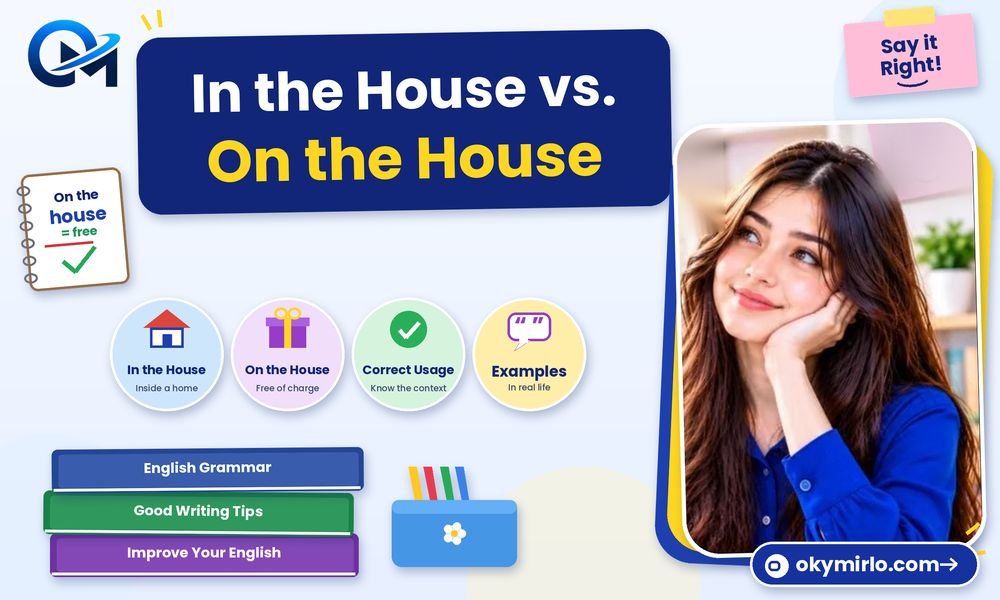

English learners and even native speakers often mix up “in the house” and “on the house.” They look similar, but they mean completely different things — one is about location, the other is about money. Understanding this distinction can save you from awkward mistakes, especially in conversations about hospitality, real estate, or everyday small talk.
In this guide, we’ll break down exactly what each phrase means, how prepositions shape meaning in American English, and how to avoid the most common errors non-native and native speakers make.
Understanding the Role of Prepositions in American English
Prepositions like in, on, and at seem tiny, but they carry enormous weight in English. A single preposition swap can completely change a sentence’s meaning.
- “In” typically refers to something enclosed, contained, or inside a three-dimensional space.
- “On” usually refers to a surface, a platform, or — in idiomatic use — an expense being absorbed by someone else.
- “At” refers to a specific point or location, often treating a place as a single reference point rather than a space.
Because English relies so heavily on these small connector words, mastering them is one of the fastest ways to sound more fluent and natural.
Read More:Bright vs. Brite: Which Is Correct? Meaning, Spelling, and Usage Explained
The Meaning and Usage of “At the House”

“At the house” refers to being at a particular location — the house as a fixed point, without emphasizing whether you’re inside or outside it.
Examples:
- “My car is at the house.”
- “We arrived at the house around 7 p.m.”
- “Let’s meet at the house before the party.”
This phrase treats the house as a destination or reference point. You could be in the yard, on the porch, or inside — “at the house” doesn’t specify.
When to Use “At”
Use “at” when:
- You’re referring to arrival or general presence near a location
- The exact position (inside or outside) isn’t important
- You’re specifying a person’s house (e.g., “at John’s house”)
Read More:Prompt Response Meaning: Definition, Usage, Examples & Difference From Quick Response
The Meaning and Usage of “In the House”
“In the house” specifically means being inside the physical structure — within its walls.
Examples:
- “The kids are playing in the house.”
- “I left my keys in the house.”
- “It’s raining, so let’s stay in the house.”
This phrase treats the house as a three-dimensional space — an enclosed volume you can be inside of.
When to Use “In”
Use “in” when:
- You want to emphasize being inside the structure, not outside
- You’re describing something contained within the house (furniture, people, rooms)
- Contrast matters — for example, distinguishing indoors from the yard or garden
“At the House” vs. “In the House”: Key Differences
| Aspect | “At the House” | “In the House” |
| Focus | The house as a point/location | The house as an enclosed space |
| Implies location precision | General (could be inside or outside) | Specific (inside only) |
| Common context | Meetings, arrivals, general presence | Physical containment, indoor activity |
| Example | “I’ll be at the house by noon.” | “I’ll be in the house watching TV.” |
| Grammatical treatment | Treats house as a single point | Treats house as three-dimensional space |
A helpful rule of thumb: if you can replace the phrase with “inside,” use “in.” If you’re simply indicating a destination or general whereabouts, use “at.”
On the House: Etymology
Unlike “in” and “at the house,” “on the house” has nothing to do with physical location. It’s an idiom meaning something is given for free by a business.
The phrase dates back to 19th-century American saloon culture. Historical references trace it to the late 1880s, when bartenders would declare a round of drinks “on the house,” meaning the cost was absorbed by the establishment itself rather than charged to the customer. In this context, “house” doesn’t mean a private residence — it’s a metonym for the business or establishment, much like how “the house always wins” refers to a casino, not a literal building.
Other related expressions include:
- “House wine” — the default wine chosen by the restaurant
- “Bring down the house” — to earn a huge audience reaction (theater origin)
- “The house” — a common way to refer to a casino, bar, or venue as an institution
On the House: Synonym
If you want alternative ways to express the same idea, here are common synonyms and equivalents:
- Complimentary
- Free of charge
- Gratis
- Compliments of the chef/management
- Comped (informal industry slang, short for “complimentary”)
Example: “Your dessert is complimentary tonight” means the same as “Your dessert is on the house tonight” — though “on the house” sounds warmer and more personal, often used by staff directly.
Interior vs. Exterior: Why the Difference Matters
The “in” vs. “at” distinction often comes down to interior versus exterior framing:
- Interior framing (“in”): Draws attention to what’s happening inside — behind closed doors, within walls.
- Exterior/neutral framing (“at”): Doesn’t specify interior or exterior — it simply marks a location.
This distinction matters in real-world scenarios. For instance, during an emergency, saying “the dog is in the house” clarifies the pet is indoors and safe, while “the dog is at the house” leaves open the possibility it’s outside in the yard. Precision here can genuinely change how a listener interprets a situation.
Cultural and Regional Insights
American English speakers tend to use “at the house” more loosely in casual speech — especially in the American South and Midwest, where “come over to the house” or “meet me at the house” are common, informal ways to refer to someone’s home without specifying “my house” directly.
“On the house,” meanwhile, is a staple of American hospitality culture — heard constantly in restaurants, bars, and hotels. It reflects an informal, customer-friendly tone that’s deeply embedded in U.S. service industry language, though it’s now used worldwide in English-speaking business contexts.
Common Mistakes and How to Avoid Them
- Confusing “on the house” with location. Some learners mistakenly think “on the house” means “on top of the house.” It doesn’t — it means “free.”
- Overusing “in” for general presence. Saying “I’ll be in the house” when you simply mean “I’ll be around” can sound overly specific or even ominous. Use “at the house” for general plans.
- Misplacing “at” for interior emphasis. If you need to clarify someone is indoors (not in the yard), “at” won’t do the job — use “in.”
- Literal translation errors. Non-native speakers sometimes translate directly from their language’s preposition system, leading to phrases like “on the house” when they mean “at home.” Always double-check idiomatic meaning, not just literal translation.
Practical Tips for Sounding More Natural
- Default to “at the house” for casual plans and meetups.
- Use “in the house” only when interior location genuinely matters.
- Reserve “on the house” strictly for free items, services, or gestures of goodwill — never for physical location.
- When in doubt, ask: Am I talking about money/free stuff, or a location? That instantly tells you whether “on” belongs in the sentence at all.
Real-Life Examples in Media and Literature
These phrases appear frequently in film, TV, and everyday dialogue:
- In restaurant and bar scenes, characters often hear a server say, “Enjoy the dessert — it’s on the house,” signaling a free treat.
- Sitcoms and dramas use “in the house” to indicate someone’s physical presence indoors, such as a parent asking, “Is your brother in the house?”
- News interviews and casual conversation frequently use “at the house” when describing where an event took place, without specifying indoor or outdoor detail.
Quick Recap: Choosing Between “At” and “In”
- At the house → general location, destination, or presence (inside or outside unspecified)
- In the house → specifically inside the structure
- On the house → free of charge, an idiom unrelated to physical location
Frequently Asked Questions
Is “on the house” always about food or drinks?
No. While most common in restaurants and bars, “on the house” can apply to any complimentary service or item, including hotel stays, event tickets, or small gifts from a business.
Can “in the house” ever mean something other than a physical location?
Yes. It’s also used figuratively, such as in hip-hop or entertainment contexts to announce someone’s presence, e.g., “DJ’s in the house!”
Is it grammatically wrong to say “on the house” to mean “at home”?
Yes, this is incorrect. “On the house” is a fixed idiom meaning free of charge; it should never be used to describe physical location.
Which phrase should I use when inviting someone over casually?
Use “at the house” — it’s the more natural, commonly used phrase for casual invitations, e.g., “Come over at the house this weekend.”
Does “on the house” work in British English the same way?
Yes. Although the idiom originated in American saloon culture, it’s now widely used and understood the same way across British and other English-speaking regions.
Conclusion
While “in the house,” “at the house,” and “on the house” might look similar at a glance, they serve entirely different purposes. “In the house” emphasizes physical containment, “at the house” refers to general location or presence, and “on the house” is a hospitality idiom meaning something is free. Mastering these small but powerful distinctions will make your English sound more precise, natural, and confident — whether you’re chatting casually, writing professionally, or navigating a restaurant menu.


Pingback: Prompt Response Meaning: Definition, Usage & Examples